
From 17-19 November, the Utrecht University members hosted the consortium for a series of workshops and discussions, sharing research and exploring the theme of collective and inclusive energy transitions.
Day 1: The CO2LAB kicked off with a workshop hosted by the University of Tartu (Estonia) team. They led us in a discussion on approaches to renovation and demolition for enabling agency, looking at the case of Kohtla-Järve which has a shrinking population and empty, dilapidated apartment blocks. This poses a challenge for renovation but also a social challenge – how best to maintain social cohesion. The demolition manager for the municipality explained in detail the dilemmas involved in considering and implementing demolition, underscoring the energy transition as socio-technical.
Day 2:
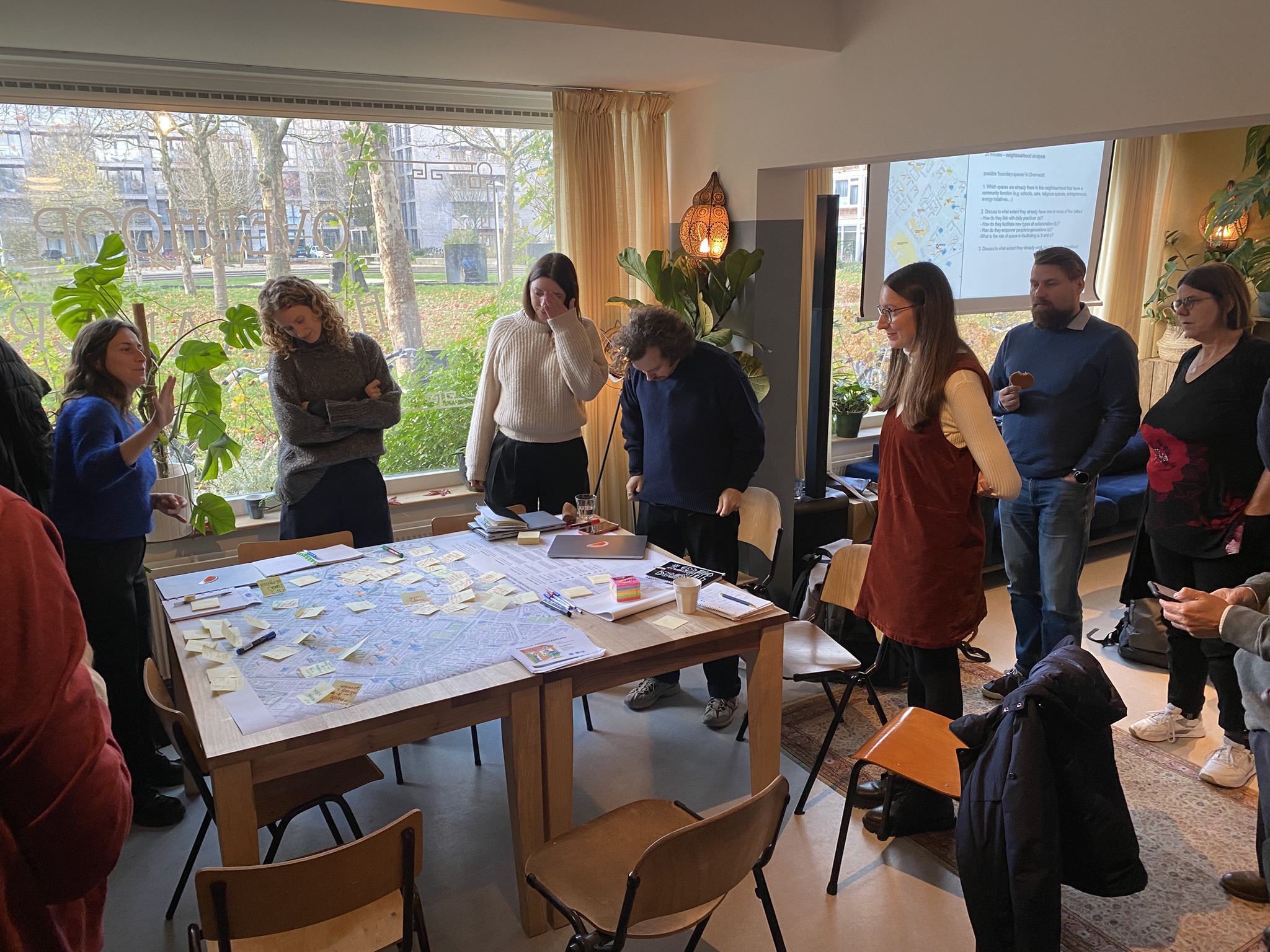
On Tuesday morning, Ghent University and co-design cooperative Endeavour (Belgium) led a workshop on boundary spaces. In the living room of social collective Overhoop, we were guided through an exercise that brought the concept of boundary spaces to Overvecht. Using their extensive maps, as well as the insight from a local community manager, we proposed different places in Overvecht which serve different social groups in the neighbourhood (and beyond), places which could serve as sites from which to enact the transition from the bottom up. We followed this up with a lecture on Radical spatial imaginations with Irene Luque Martin from TU Delft. Coming from urban design, the lecture confronted the group with a different perspective on visioning for spatial justice. It left us with questions such as: what limits the imagination? What worlds do we refuse? When are we not necessary?
We concluded the second day of the lab with an open panel discussion on the topic of research fatigue in marginalized neighbourhoods. Guest speakers Seline Westerhof (Erasmus University / WijkWijs collective) and Simone van de Wetering (Tilburg University) joined an audience of consortium members, researchers, and students. We had a wide-ranging conversation about our varied experiences doing research and encountering the limits of participants’ patience for projects that don’t appear to connect to lived realities or give back to communities. For a project focused on marginalized neighbourhoods, this discussion was crucial, given the imperative to do research with and for the people who live there.
Day 3:
On the final day, we braved the cold and rain for a final workshop and consortium planning session.
In the morning we gathered in a community centre in Ondiep for the University of Aveiro (Portugal) workshop on “Co-evolution between Public and Community Stakeholders." Here we tested the Key Performance Indicators designed for inclusive, sustainable, and energy-efficient neighbourhoods in two Porto neighbourhoods, applying them to the case-studies we are familiar with. This emphasized the importance of context, but also the role of communication between communities and state institutions for successful interventions. Finally, we gathered in greenhouse of Utrecht University’s Botanic gardens to reflect on the past days of co-creation and to think ahead to our consortium outcomes. Now over halfway through the project, we are building on the next chapter in our collective work for inclusive energy transitions.

